On this page
The Results Player displays numerical values from a CSV file directly in composite structure diagrams, such as Internal Block Diagram, Parametric, etc. This allows you to review the simulation results, specific time steps, and display results of an external simulation (for example, a SSP export).
You can view the active States for the selected parts in the Results Player when you load a CSV file. To learn more about how to export active States for the parts, refer the CSV export page.
You can view an image of the active state next to the state label in the Results Player. Each state machine supports only one active state; Composite and orthogonal states are not supported. To learn more, refer to the Displaying simulation information page.
|
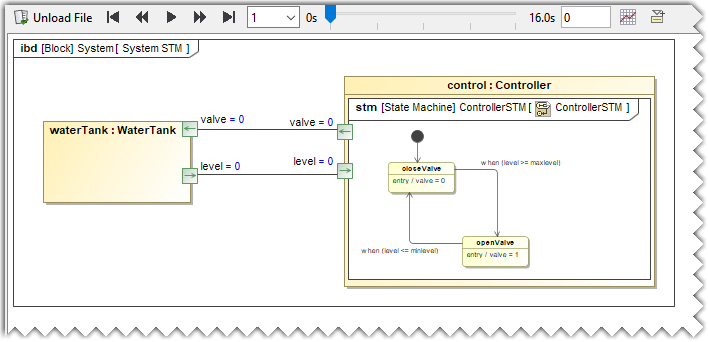
The Results Player when a file is loaded.
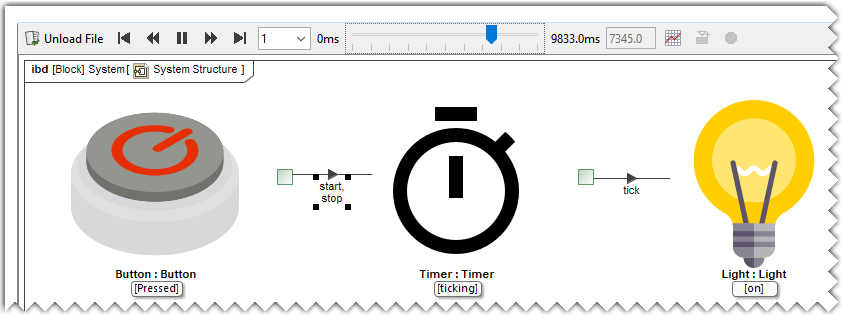
Active State Image displayed when the file is loaded in the Results Player.
Understanding the UI components of the Results Player
The following table describes the UI components of the Results Player:
| Icon | Name | Description | ||||
|---|---|---|---|---|---|---|
| Load/Unload File | Selects a CSV export file to load/Deselects the CSV export file. | ||||
| Beginning | Stops the play and jumps to the first step. | ||||
| Step Backward | Jumps to the previous step. | ||||
| Play | Starts automatic playback of time values in real-time. | ||||
| Step Forward | Jumps to the next step. | ||||
| End | Stops the play and jumps to the last step. | ||||
| Playback speed | Controls the playback speed. | ||||
| Slider | Displays the current position and allows you to manually scroll through the values. | ||||
| Time indicator | Shows the current step and allows you to manually enter the desired time value. | ||||
| Time Series Chart | Generates the Time Series Chart. | ||||
| Export to Instance | Generates the Instance. | ||||
| Verify Requirements | Verifies the requirements present in the loaded CSV file.
|





Launching the Results Player
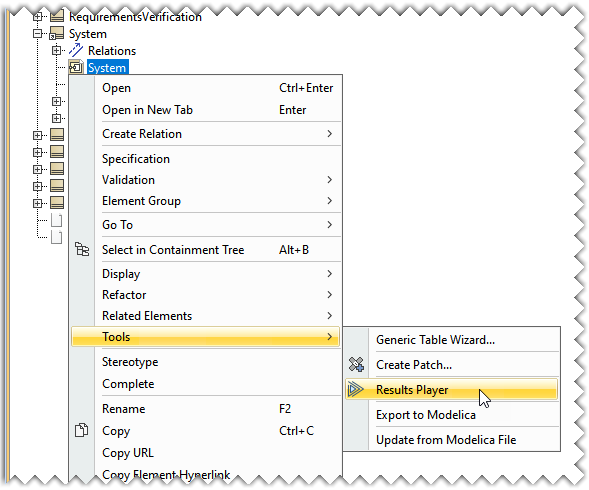
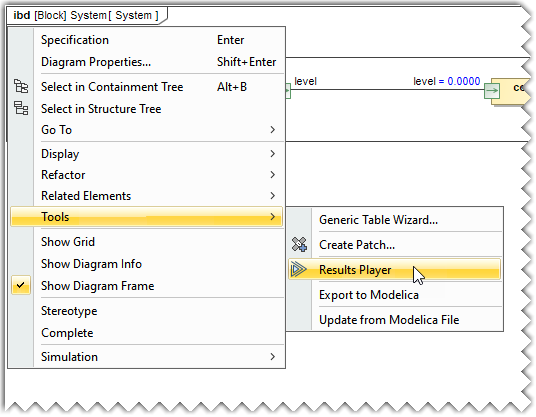
You can launch the Results Player both through the Containment tree and the composite structure diagram.
To launch the Results Player
- In the Containment tree, right-click the composite structure diagram and select Tools> Results Player.
- In the composite structure diagram, right-click anywhere and select Tools>Results Player.
Loading CSV export file
|
You must load the CSV export file to be able to use the Results Player. You can load the CSV export file either manually or automatically after the simulation terminates.
To load the CSV export file manually
- Click on the Load File command in the Results Player.
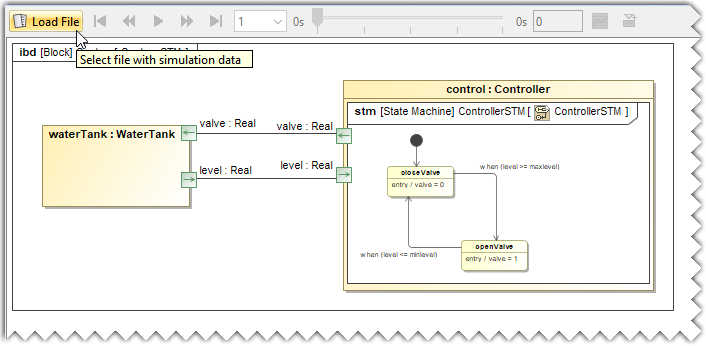
- In the Open dialog, select the CSV file and click Open.
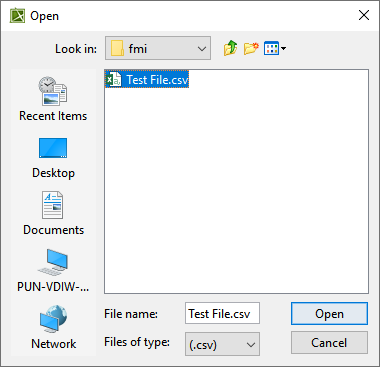
|
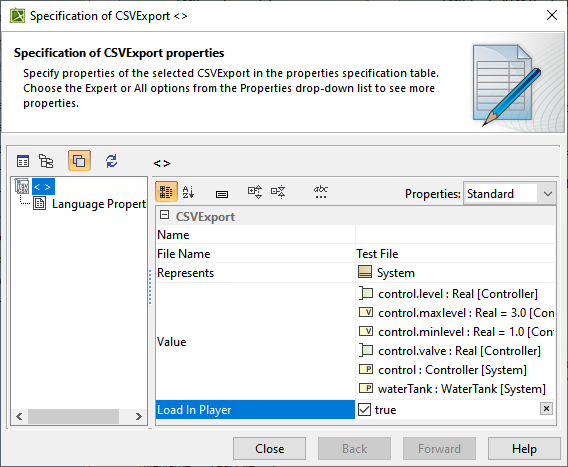
To load a CSV export file automatically when a simulation terminates:
- In the Specification of CSV export dialog, set the Load in Player property to true.
Generating a Time Series Chart
You can generate a Time Series Chart with help of Results Player.
To generate a Time Series Chart
- Click the
 icon, found on the Result Player.
 - From the contextual menu, select the required values and click OK.
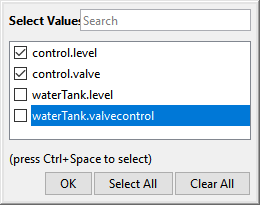
While selecting values in the dialog, you can add up to ten values at a time. If there are more than ten values, click Select All to select the initial ten values in the dialog.
The generated Time Series Chart is displayed for the selected values. You can also change/update the values by clicking the  icon in the Time Series Chart. You can generate multiple charts with different values at the same time. When a CSV file is unloaded, charts are deactivated, but remain open for a reference. Additionally, you can load a new CSV export file and generate new Time Series Charts. A black vertical line indicates the current time step and you can change the time step by clicking on the chart.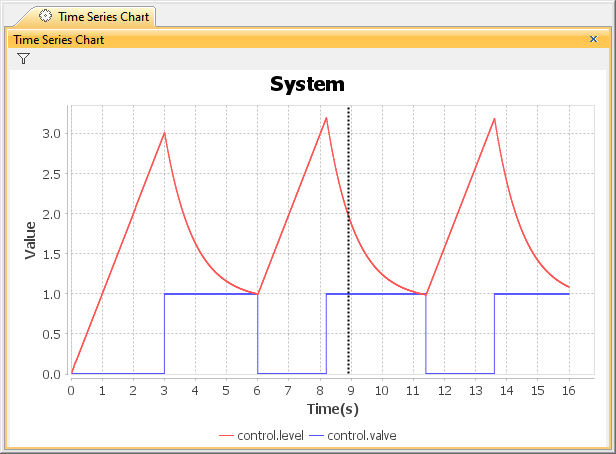
Time Series Chart
When you export the CSV file automatically and specify the Time Series chart in the simulation configuration, the Time Series chart is generated automatically with the same values as the original configuration. |
Exporting the current step to an Instance Specification
To export the current step to an Instance Specification
- Click the
 icon present on the Result Player.
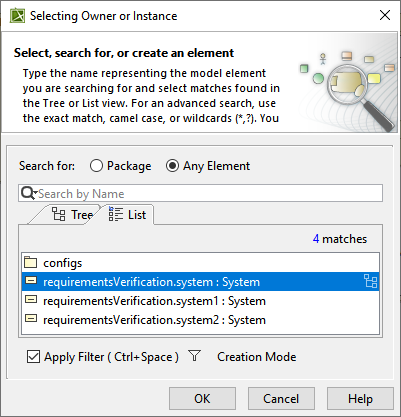
 - From the Selecting Owner or Instance dialog, select a Package to generate a new instance, or select an existing instance to update its values. Click OK.
|
Verifying the Requirements
You can verify requirements in the Results Player when you export the CSV file. You can verify requirements that are specified with the help of the Requirement patterns; however, the requirements specified using a constraint block are not supported. To learn more about how to use the requirement patterns, refer to the Requirement Patterns glossary.
To verify the requirements
- Load the CSV export file. To learn more, refer to Results Player#Loading CSV export file section.
- Click
 icon present on the Results Player.
The Verify Requirements command is disabled if no requirements in the context are compatible |
Once you click the Verify Requirements icon, the icon is updated with a red or green dot in it. The  icon indicates that the verification is successful and no requirements have failed. The
  icon indicates that some of the requirements have failed. In the Block diagram, the label of a verified value is displayed green if it is passing at the current time step, and it is displayed red if it is failing at the current time step. A tooltip along with the red label is displayed for the failing value. Also, the failing regions are highlighted in red on the Slider for the failed requirements.
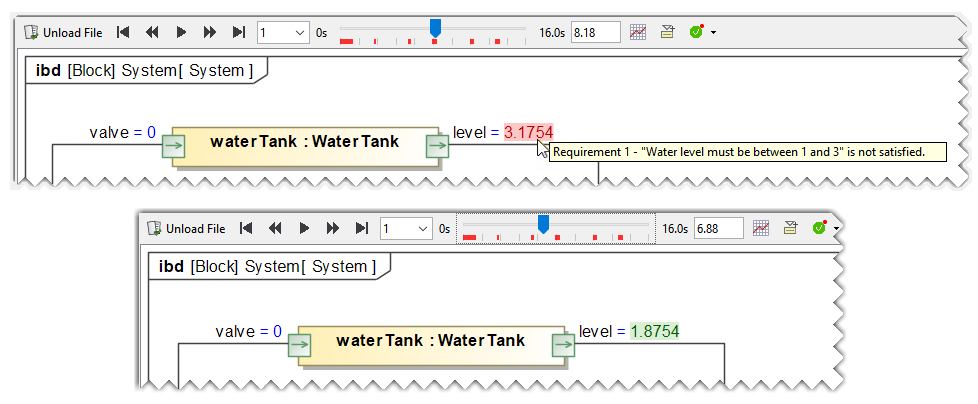
A red label with tooltip, a green label and failing region on the Slider displayed in the Block diagram and on the Results Player respectively.
Requirement verification also has a drop down menu with extra commands to increase the usability.
Sr. No. | Icon | Description |
|---|---|---|
1 |
| The default action is same as the main command. |
2 |
| The command exports all mapped data to a new CSV file and adds a column with requirements verification results. For example, if the verified requirement is WaterLevel, then the requirements verification results column is added after the WaterLevel column. The name of the added column includes ID and name of the requirement. |
3 |
| Clears the verified results. |


