For the documentation related to UAF 1.2, please see the UAF 1.2 Plugin Documentation. |
The Unified Architecture Framework (UAF) supports the capability to:
According to modeling needs, there are the following UAF templates for different purposes:
Please make sure, that the UAF 1.2 Plugin is installed. |
*Starting with the 2024x version, the UAF Enterprise Architecture Project was renamed to EA with BPMN Project.
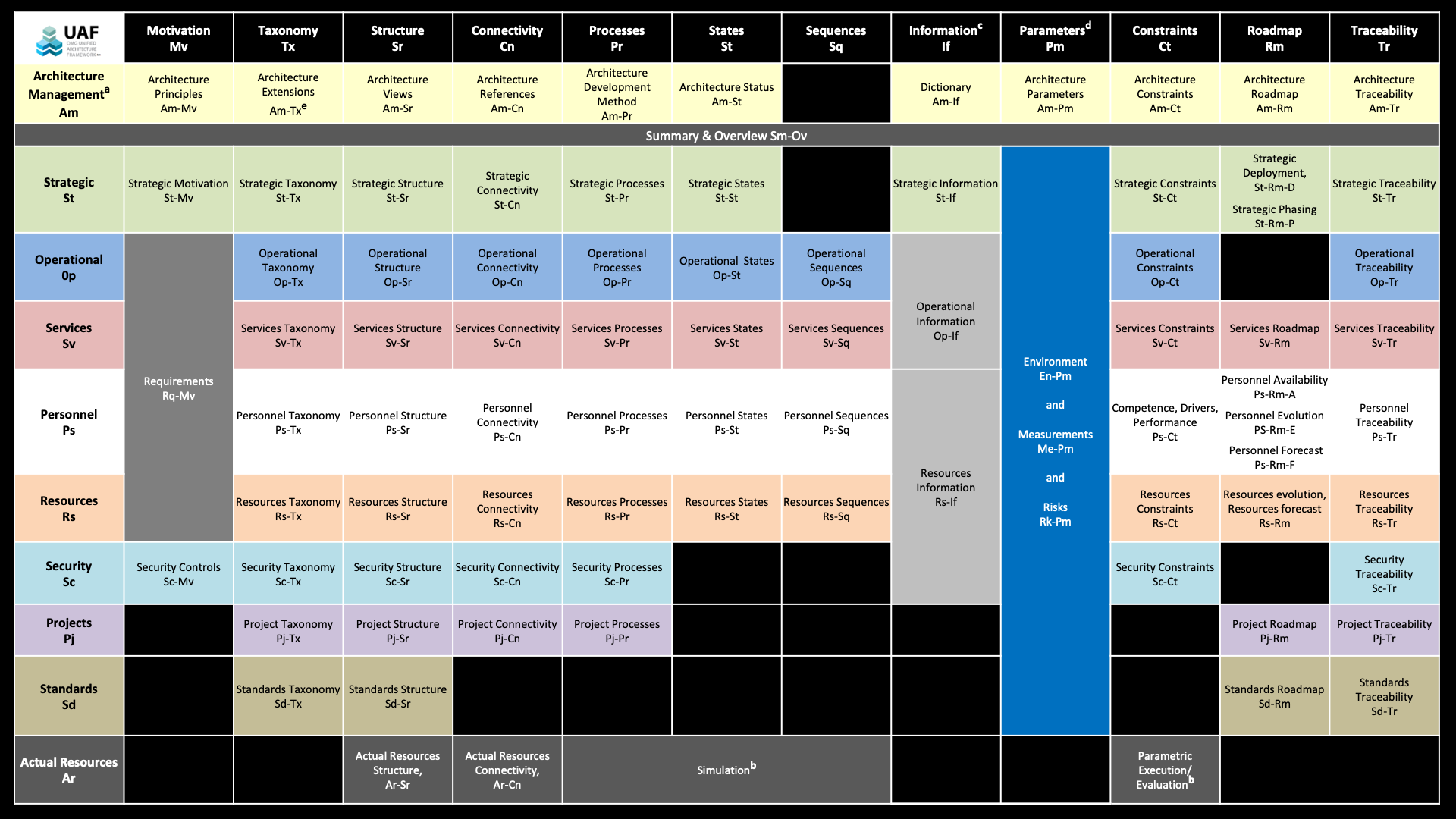
The descriptions of all the viewpoints are provided in the following table:
Viewpoint | Acronym | Description |
|---|---|---|
Architecture Management | Am | Identifies the metadata required to develop a suitable architecture that is fit for its purpose. |
Strategic | St | Capability management process. Describes the capability taxonomy, composition, dependencies, and evolution. |
Operational | Op | Illustrates the Logical Architecture of the enterprise. Describes the requirements, operational behavior, structure, and exchanges required to support (exhibit) capabilities. Defines all operational elements in an implementation/solution-independent manner. |
Services | Sv | The Service-Orientated View (SOV) is a description of services needed to directly support the operational domain as described in the Operational View. A service within MODAF is understood in its broadest sense, as a unit of work through which a provider provides a useful result to a consumer. DoDAF: The Service Views within the Services Viewpoint describe the design for service-based solutions to support operational development processes (JCIDS) and Defense Acquisition System or capability development within the Joint Capability Areas. |
Personnel | Ps | Defines and explores organizational resource types. Shows the taxonomy of types of organizational resources as well as connections, interaction, and growth over time. |
Resources | Rs | Captures a solution architecture consisting of resources, e.g., organizational, software, artifacts, capability configurations, and natural resources that implement the operational requirements. Further design of a resource is typically detailed in SysML or UML. |
Security | Sc | Security assets and security enclaves. Defines the hierarchy of security assets and asset owners, security constraints (policy, laws, and guidance), and details where they are located (security enclaves). |
Projects | Pj | Describes projects and project milestones, how those projects deliver capabilities, the organizations contributing to the projects, and dependencies between projects. |
Standards | Sd | MODAF: Technical Standards Views are extended from the core DoDAF views to include non-technical standards such as operational doctrine, industry process standards, etc. DoDAF: The Standards Views within the Standards Viewpoint are the set of rules governing the arrangement, interaction, and interdependence of solution parts or elements. |
Actual Resources | Ar | The analysis, e.g., evaluation of different alternatives, what-if, trade-offs, V&V on the actual resource configurations. Illustrates the expected or achieved actual resource configurations. |
The descriptions of all the aspects are provided in the following table:
| Aspect | Acronym | Description |
|---|---|---|
| Motivation | Mv | Captures motivational elements e.g., challenges, opportunities, and concerns, that pertain to enterprise transformation efforts, and different types of requirements, e.g., operational, services, personnel, resources, or security controls. |
| Taxonomy | Tx | Presents all the elements as a standalone structure. Presents all the elements as a specialization hierarchy, provides a text definition for each one and references the source of the element. |
| Structure | Sr | Describes the breakdown of structural elements e.g. logical performers, systems, projects, etc. into their smaller parts. |
| Connectivity | Cn | Describes the connections, relationships, and interactions between the different elements. |
| Processes | Pr | Captures activity-based behavior and flows. It describes activities, their Inputs/Outputs, activity actions, and flows between them. |
| States | St | Captures state-based behavior of an element. It is a graphical representation of states of a structural element and how it responds to various events and actions. |
| Sequences | Sq | Expresses a time-ordered examination of the exchanges as a result of a particular scenario. Provides a time-ordered examination of the exchanges between participating elements as a result of a particular scenario. |
| Information | If | Address the information perspective on operational, service, and resource architectures. Allows analysis of an architecture’s information and data definition aspect, without consideration of implementation-specific issues. |
| Parameters | Pm | Shows the measurable properties of something in the physical world and elements and relationships that are involved in defining the environments applicable to capability, operational concept or set of systems. |
| Constraints | Ct | Details the measurements that set performance requirements constraining capabilities. Also defines the rules governing behavior and structure. |
| Roadmap | Rm | Addresses how elements in the architecture change over time. |
| Traceability | Tr | Describes the mapping between elements in the architecture. This can be between different viewpoints within domains as well as between domains. It can also be between structure and behaviors. |