ESCO (European Skills, Competences, Qualifications and Occupations) is the European multilingual classification of Skills, Competencies, and Occupations.
ESCO works as a dictionary, describing, identifying, and classifying professional occupations and skills relevant to the labor market, along with education and training.
Using ESCO provides multiple values:
- Improved Job Matching & Skills Development: Standardized terminology for skills and business roles enhancing job matching, reducing skills gaps, and supporting personalized learning paths.
- Cross-Border and Cross-Value Chain Consistency & Mobility: Multilingual standardization facilitates the recognition of skills and qualifications across countries, boosting workforce mobility, and standardizing HR processes.
- Data-Driven Insights & Policy Alignment: Roles and skills standardization enables access to labor market data for organizational process benchmarking.
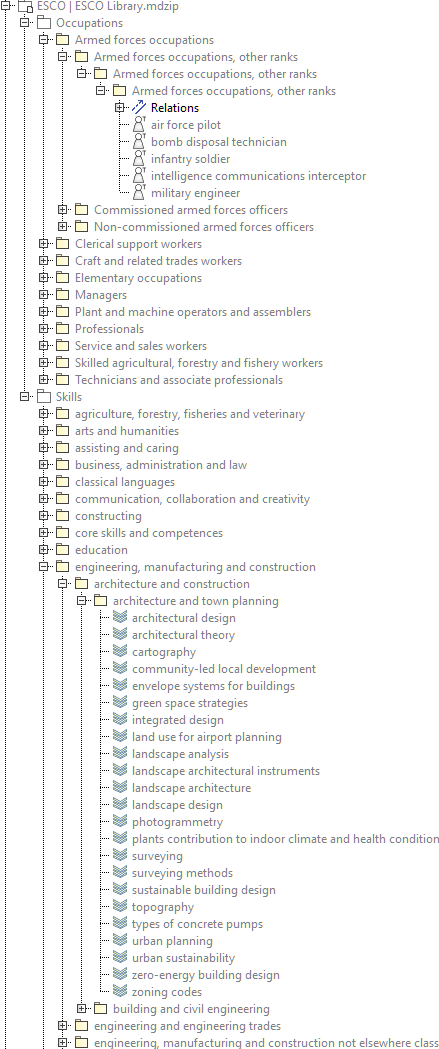
The VTO plug-in includes data from ESCO version 1.2.0 that is ready to use for the Enterprise Architect. The data is organized into two categories: Occupations (aka roles), and Competencies (aka skills). Relations have been imported between roles and skills, but only essential skills have been considered.
UAF types from the Personnel viewpoint are used for representing ESCO data: UAF Post for modeling ESCO Occupations, and UAF Competence for modeling ESCO Competencies.
Relations use the UAF Requires Competence relation.