

Description
The P4 Resource Functions view addresses resource (human and non-human) functions – i.e. the activities performed by Resources.
The primary purposes of the P4 view are to:
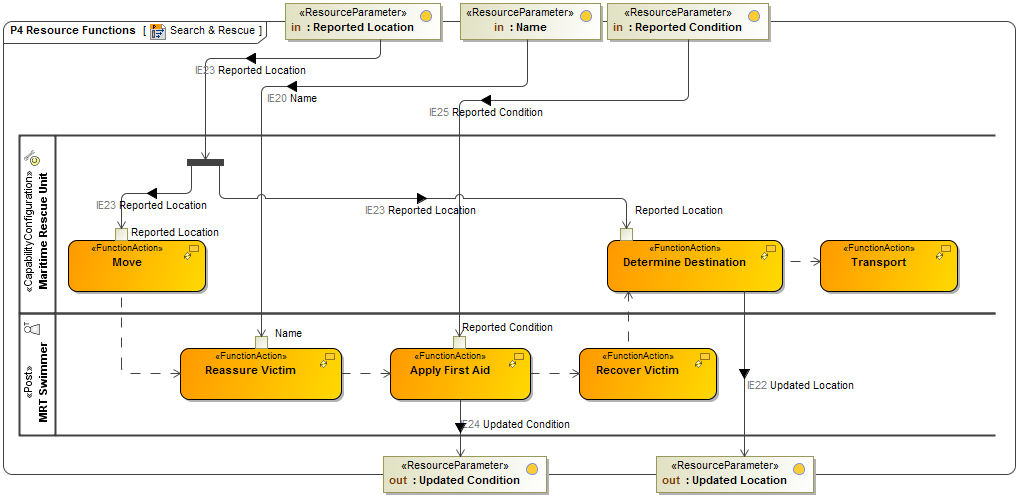
- Develop a clear description of the necessary data flows that are input (consumed) by and output (produced) by each resource.
- Ensure that the functional connectivity is complete (i.e. that a resource’s required inputs are all satisfied).
- Ensure that the functional decomposition reaches an appropriate level of detail.
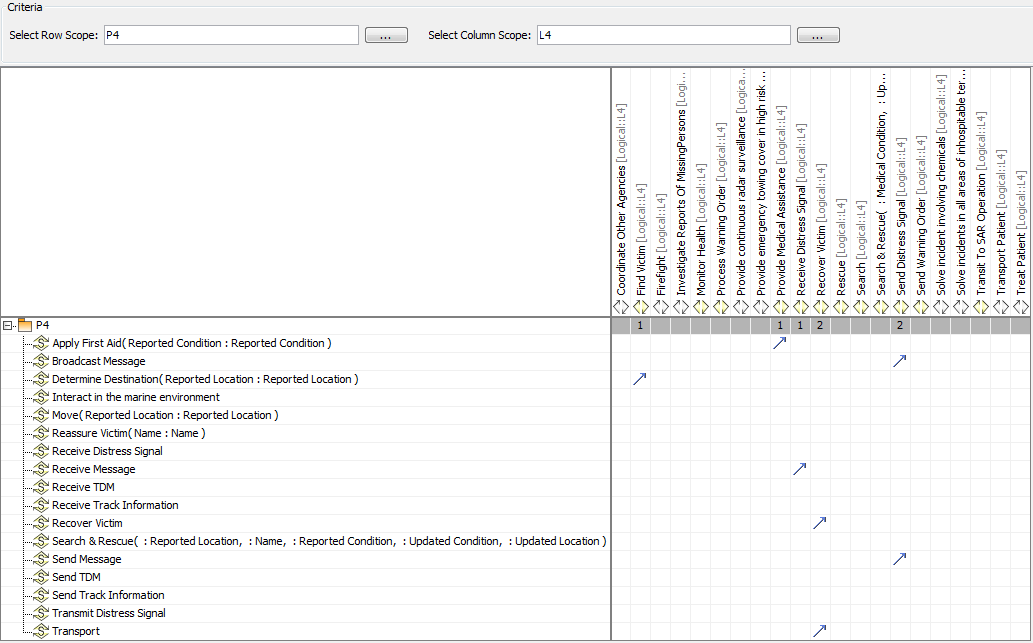
- Provide implementation-specific realizations of the operational activities specified in the L4 Logical Activities view.
The Functionality Description provides detailed information regarding the:
- Allocation of functions to resources.
- Flow of data between functions.
The P4 view is the systems view counterpart to the Activity Model (L4 Logical Activities) of the operational view.
The P4 view may be used for:
- Description of task workflow.
- Identification of functional system requirements.
- Functional decomposition of systems.
- Relate human and system functions.
Implementation
The P4 view can be represented using:
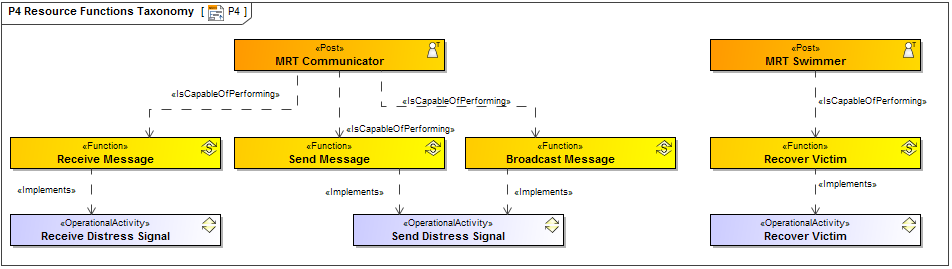
- P4 Resource Functions Taxonomy diagram for Function hierarchies. This diagram is based on the UML Class diagram.
- P4 Resource Functions diagram for Function flows. This diagram is based on the UML Activity diagram.
- L4-P4 Systems Function to Operational Activity Traceability Matrix.
- UML Class diagram.
- UML Activity diagram.
- SysML Block diagram.
- SysML Activity diagram.
Related elements
- Function
- Operational Activity
- Standard Operational Activity
- Resource Artifact
- Software
- Capability Configuration
- Organization
- Post
- Is Capable To Perform
- Function Action
- Function Control Flow
- Function Object Flow
- Resource Exchange
- Data Element
- Natural Resource
Related procedures